
Architecture#
OrbitTE follows frozen Mooncake TENT’s engine, transport, context, registered buffer, endpoint and worker boundaries. The host TCP/RDMA data path exists; full TENT behavior, native wire compatibility and complete P4 acceptance remain open. Read capabilities for support and the P4 exit queue for missing work.
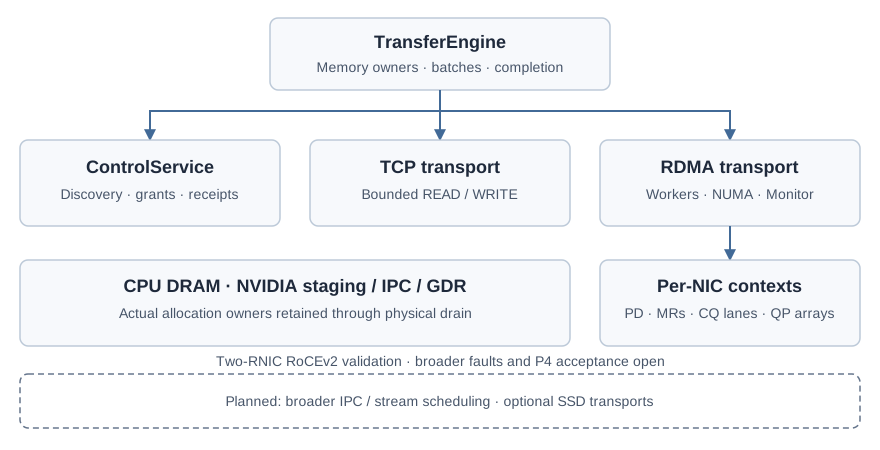
Engine and transport boundary#
TransferEngine owns registration, batches, admission and directional shutdown.
RegisteredMemory retains actual backing; aliases share allocation-level
access coordination. runtime::control_plane::ControlService owns peer lookup,
request framing and source handlers. It dispatches payload work to sibling
TcpTransport and RdmaTransport implementations.
RDMA uses the control connection to negotiate paths, connections and exact
memory grants. Payload bytes go through verbs. rdma::protocol defines the
OrbitTE v19 messages; moving them into their own module does not make this
protocol compatible with TENT’s native RPC or metadata.
RDMA resource owners#
Owner |
Resource and lifetime |
Frozen TENT correspondence |
|---|---|---|
|
Context slots, registrations, workers and parent dispatch |
|
|
Stable NIC IDs, actual context/PD, route and persistent key domain |
|
|
Persistent host MRs keyed by actual context, allocation view and capability |
Context-keyed |
|
Peer identity, fixed-width construction slots and persistent QPs across CQ lanes |
Context endpoint store, |
|
One actual QP shared by independently retained grant records; CQ-local lookup and retirement |
Endpoint QPs and affiliated slice ownership |
|
Physical QP send depth, exact outstanding WR IDs and fenced admission |
Per-QP |
|
QP-owned receive buffers/MRs, RQ debt and binding/key dispatch |
QP-owned receive WRs; exact grant receipts are a Rust extension |
|
One exact-range DMA loan, source MW, SEND message storage and grant charge |
Rust authority extension over TENT’s registered-region model |
|
Per-grant geometry, WR windows and independent completion identities |
|
|
SQ/RQ CQ pair, registered grant records, submission, drain and recovery |
Per-context CQs consumed by workers |
|
Transport data threads, lane assignment and unfinished-grant load |
|
|
One transport thread consuming events and driving periodic context reclaim/recovery |
|
|
NIC byte load, aggregate SQ/RQ wakes and whole-parent grant/receive admission |
Device selection and bounded slice admission; OrbitTE’s receive-credit protocol is additional |
Each context slot owns its PD/context, CQ lanes and peer endpoint registry.
RdmaQp serializes one physical connection; each CQ-lane Record owns one
grant’s state, namespaces, work and waiters. Multiple records can retain the
same QP. The connection retains its SendQueue and ReceiveQueue across grants. SendWork borrows
the shared SQ; ReceiveWork tracks an exact binding/key receipt independently
of the buffer that receives it. A live grant
retains its lane, worker pool and peer endpoint. Peer arrays retain QP records
and weak lane references, avoiding an endpoint/lane ownership cycle.
Native cleanup is fallible. A failed QP/MR/MW/CQ/channel teardown retains the remaining owner, backing and charges; a timeout or terminal task state cannot substitute for physical drain. A separate shared thirty-second parent destruction window preserves the original data failure unless cleanup reports unquiesced work. The native cleanup gate checks these owners after failed destruction and explains the difference from TENT’s retry policy.
The installed physical rail gate
checks these boundaries outside the crate: native context identity selects the
physical RNIC, accepted WRs consume the shared QP, and successful CQEs account
for exact slice bytes. TENT’s Workers::markPosted and releaseSliceQuota
similarly associate completion with posted work. OrbitTE additionally keeps
its grant and backing charges through the source receipt; a payload CQE alone
does not retire that ownership.
Fixed-width cold construction#
EndpointStore::get_or_insert gives every caller the same RdmaEndpoint, even
while the first builder has not created a QP. Each array has
min(local.num_lanes, remote.num_lanes) slots, negotiated before any slice is
prepared. Its key includes the local context, remote process/PD and NIC path,
requester/source role and READ/WRITE capability. Opposite roles do not wait on
one another. Staged/device paths advertise zero reusable width and retain
their existing per-grant physical connection budget.
An uncloneable Construction reserves a slot under the endpoint mutex. It
attaches the actual QP owner before native creation, then survives until the
bilateral connection is published. An unpublished slot cannot be shared.
Waiters release all store/endpoint locks and use their own deadlines; they
cannot cancel the builder. Cancellation releases an unbound slot immediately,
but a created QP occupies its slot until native destruction succeeds. A unique
reservation token prevents an old guard from releasing a replacement slot.
The source publishes its connected pair before sending GRANT. A subsequent handshake therefore finds that exact pair as soon as the requester can share it. Duplicate cold bootstraps join the same remote connection identity. Fresh bootstrap after a peer discarded a QP can retire an old idle pair in that array, using the existing all-affiliates-finished check; active siblings are never evicted to make a slot. Malformed path metadata rejects the new request without replacing an established connection. Whole-parent grant/RQ admission remains separate, so more slices than QPs can be prepared without waiting for payload completion.
Frozen TENT uses EndpointStore::getOrInsert, RdmaEndPoint::construct and
EP_HANDSHAKING/EP_READY; its connect path releases the endpoint lock for
bootstrap RPC and revalidates on return. OrbitTE expresses that ownership with
bounded slots and Rust guards. TENT’s eager, bidirectional QP list and native
bootstrap format differ from OrbitTE’s lazy, capability-specific grant protocol.
QP send ownership#
ConnectionResources::send_queue owns the physical SQ’s unresolved WR IDs.
It admits at most max_send_wr across all work sharing that QP while also
charging the aggregate CQ budget. Each grant’s SendWork keeps its
geometry, window and completion state; payload, MW bind and completion SEND
all use the connection’s same queue. Post receipts return only a proven
unaccepted suffix. Unknown posts retain the entire possible debt and fence new
admission. A validated CQE discharges its exact posted WR once.
Dropping a work handle cannot return SQ credits. QP close fences admission; cancellation clears unresolved debt only after all QPs and both CQs have closed. Failed native destruction retains the queue with its connection and backing. The native fault fixtures compare this queue against observed accepted-minus-delivered WRs before CQ destruction.
Concurrent runtime records now share this queue. Each record publishes its own send namespace, and CQ lookup resolves the exact record before checking QPN, WR identity and operation. Submission borrows the SQ directly so a sibling’s native QP call cannot block logical work admission. Native access follows grant → QP → context lock order; connection identity is published under the QP creation lock. The public v19 handshake can attach independent grants to a connected QP. The observed previous grant is a lower bound, while both process and connection identities still match exactly. Endpoint observations only move forward when concurrent handshakes arrive out of order. Cold construction reserves the same fixed array used for established pairs.
GPU source grants use a private PD and exact-range MR because PeerDirect cannot
bind MWs. Their fresh QPs still use context CQ lanes and transport Workers.
cuda/rdma.rs owns SYNC_MEMOPS preparation, range exclusion and consumer-visible
completion; GrantResources and ConnectionResources own native MR/PD teardown.
See GPU ownership for the TENT correspondence
and the separate source/requester reuse policies.
QP receive ownership#
ConnectionResources::receive_queue owns registered receive slots and their
parent admission credits. A successful RQ CQE names the consumed buffer by WR
ID; its full 141-byte binding and invalidated rkey identify the grant receipt.
The buffer’s donor is not used to identify the completed grant. ReceiveWork
holds immutable binding/key/deadline metadata and independent posted/completed
state. Dropping that handle cannot release an unresolved receive slot.
Completing grant B through buffer A releases A’s RQ debt. B’s donated buffer remains QP-owned until its own CQE or physical drain, even after B is released. Reaping completed buffers preserves prepared but unposted slots. Duplicate, stale or mismatched messages cannot complete another receipt. Ambiguous posts retain buffer/MR/credit ownership; cancellation requires QP/CQ destruction. Failed message-MR cleanup retains the actual queue along with its connection.
Native SQ depth uses max_send_wr; RQ depth uses max_cqes so an entire
parent can prepare receives even when its grants exceed the physical SQ width.
Each queue has a separate aggregate CQ budget. Receive credits remain charged
until the consumed buffer’s MR is reaped, including native cleanup failure. TENT likewise owns WRs at the physical
endpoint/QP and dispatches CQEs to work identities. This full-binding source
receipt protocol is an OrbitTE authority extension, not TENT wire parity.
The lane locates the physical RQ by slot identity, releases its lock, then
locks the grant named by the receipt. It clears that grant’s bound authority
before publishing completion or waking its waiter. The donor record may already
have left lookup: its pending slot/MR stays with RdmaQp.
Successful grants can retire independently. Physical cancellation fences every affiliated record and drains the connection once; unresolved work still requires all QPs and both CQs to close. Retention counts each physical QP/SQ/RQ once and each grant/loan separately. A stale claim or replaced idle record has no authority to retire a sibling or later grant. The native shared-QP fixture exercises these owners directly. The public handshake uses the same owners and fixed-width construction reservations. See qualification for the tested scope.
Follow one transfer#
Register. Host Direct publication prepares local-only MRs and separate MW-bind parents in every usable context before making the range visible, including contexts whose selected port is paused. Partial failures roll back only newly created copies. Device masks restrict dispatch, not MR publication; paused contexts cannot supply a transfer path.
Plan. The transport partitions large parents with TENT’s bounded, short-tail-folding geometry. Static
pathmetadata checks compatible peers;DeviceSelectorapplies device masks, topology ranks and byte charges.Authorize. Both peers reserve the whole parent’s
max_grantsbudget; the source also reserves all RQ credits before exposing the first grant. Each grant owns a reservation slot; the parent’s reservation survives until all its actual children drain. Failed source RQ admission rolls back its grant reservation before any QP or authority is created. Rendezvous verifies both process/connection identities, source NIC/PD and grant generation. A fresh one-use MW authorizes only the requested range. All slices are prepared before payload submission.Progress.
num_lanessets both transport worker count and each context’s CQ-pair count. Workeripolls laneiacross contexts. New grants choose the least-loaded lane with rotating ties; reused QPs keep their original lane. Grant-ownedSliceLeaseremains charged through drain or quarantine.Complete. Native data completion, same-QP fenced completion messaging, the exact source receive/invalidation and bound DONE/ACK/READY receipts establish grant drain. Every slice must finish before its parent succeeds. Staged output is copied only after the required proof. Ambiguous WRITEs are not replayed automatically.
All contexts share aggregate byte, physical QP, grant and SQ/RQ limits. A QP is idle and evictable only when every affiliated grant is finished. Cancelling an unattached claim discards that record without fencing an active sibling. Quota return wakes waiting lanes even when they have no local CQE to wake them. Completely drained faulted lanes can be replaced while the PD, persistent MRs and worker pool stay alive. Workers bind before admission to NUMA CPU sets intersected with the creator’s allowed mask; this does not place application pages near an RNIC.
The monitor serializes native get/ACK with event-source detachment. CQ channels stay lane-owned; async FDs stay device-owned. Native owners close only after detachment. Lost event-consumption proof fences the affected device and retains unproven native resources. See the lifetime contracts for exact failure transitions and qualification for scoped evidence.
Periodic monitor reclaim and port recovery#
The transport’s existing monitor scans its registered context set once per second, including when applications submit no new work. It removes faulted CQ lanes only after data workers have closed native QPs/CQs and detached. Endpoint slots are reclaimed only when their physical QP is closed; retained cleanup failures remain charged. The monitor uses nonblocking context, lane and QP inspection so a native destructor waiting for event ACK cannot stall its ACK consumer. Transport shutdown detaches the weak context registration before dropping resource owners; the monitor cannot become their last owner.
Discovery retains a context with valid device/GID metadata even when its port
starts down. events::State::check_device permits persistent MR registration
on its usable PD; route operations also require check, which rejects paused
ports. Device-fatal or lost-consumer faults still block registration.
RdmaContext::refresh_address queries the selected native port/GID tuple while
healthy. Paused recovery repeats automatic GID selection on that same port;
explicit device/port/GID pins stay strict. Down ports and changed GID/LID/MTU
fence admission and wake every old lane.
PORT_ERR, PORT_ACTIVE, GID_CHANGE and LID_CHANGE apply only to the selected
port, though all native events are acknowledged. A monotonic route generation
prevents an older query result from clearing a newer fault. Recovery requires
all old lanes and endpoint construction slots to drain, a successful native
query and unchanged fault generation. It publishes the new address and restores
DeviceSelector availability under the context-set lock. Missing PORT_ACTIVE
events therefore do not require an application request to trigger recovery.
Device-fatal events, lost event consumers and retained owners cannot be healed
by a successful port query.
Frozen TENT’s monitor performs a similar one-second reclaim/resume pass;
activateContext pauses selection, refreshes the address and evicts old
endpoints before enabling. OrbitTE keeps physical destruction in its data
workers and waits for their native drain proof. It preserves PD/key domains and
persistent MRs. When the peer discarded several cached QPs, bootstrap may
consume one explicit CACHE_MISS per array slot before a fresh handshake;
the original deadline still applies and payload submission has not begun.
This does not retry an ambiguous data transfer.
Initially paused context retention and automatic GID reselection have CPU coverage and a scoped one-RNIC native gate; source and recorded evidence passed independent review with fresh live RoCE repeats. New-device hotplug, link-bandwidth policy and physical fabric/device-loss qualification remain open. See the recovery contract and qualification.
Source reading order#
Start at an operation, then follow the resource it borrows. Child modules extend their resource owner; submission and cleanup stay beside the resources they protect.
Read |
Location |
Responsibility |
|---|---|---|
Public request |
|
Engine, tasks and actual backing |
Transport entry |
|
Registration, parent dispatch and source serving |
Context orchestration |
|
Transport initialization, selection, CQ attachment, recovery and shutdown |
Context owners |
|
Stable slots and reclaim, PD/key history and exhausted MWs, device discovery and NIC admission |
Peer rendezvous |
|
Fixed-width connection claims, grant preparation and bilateral publication |
Wire data |
|
OrbitTE grant receipts and static NIC/PD path metadata |
Persistent owners |
|
MR, peer, QP and exclusive grant lifetime |
QP work ownership |
|
Physical SQ/RQ ownership, independent grant work and binding/key receive dispatch |
CQ execution |
|
Lane lifecycle, admission/waits, drained reuse, CQE dispatch and native progress |
Scheduling and events |
|
Data threads, event consumer and actual CQ/channel owners |
Verbs boundary |
|
Fallible function table and native calls grouped by resource |
Staging |
|
Shared pinned chunks, scoped remote operations, independent requester/source rings, GPU range loans and CUDA copy/drain |
Host and GPU |
|
Host discovery/worker binding, NVIDIA copy and GPU DMA owners |
rdma_transport/contexts.rs extends RdmaTransport; context_set.rs owns only
the slot state and its monitor-driven reclaim. The methods retain their existing
lock scopes, call order and visibility to the RDMA module. This mirrors TENT’s
transport-owned RdmaContextSet and context-owned PD/CQ/endpoint resources
without introducing a forwarding owner or changing cleanup semantics.
Paths after the transport entry are relative to src/transport/rdma/, except
the public, host and GPU rows, which are relative to src/.
The installed host fixture in tests/hardware/rdma_host.rs crosses these owners
through the public engine API. build_installed.py builds it as a separate
consumer of an extracted .crate. rdma_host/resources.rs owns registration
and drain; rdma_host/restart.rs owns repeated peer death while the other
engine stays live. rdma_host/interruption.rs owns pending public batches and
drain assertions; rdma_host/gate.rs owns the bounded test control relay that
holds GRANT after source RQ posting and rejects TCP payload opcodes.
run.py/supervise.py own exact-child supervision; installed.py,
installed_restart.py and installed_interruption.py independently reconcile
native resource, byte and process receipts. rdma_host/completion.rs controls
the separate packaged native CQ-loss tool. installed_completion.py joins
accepted WRs, actual successful CQEs and real QP destruction before accepting
the public drain result. This explicit test profile intercepts provider calls
in the requester only; normal package consumers do not load the tool.
Failed lanes are reclaimed before replacement CQs are created on demand; subsequent healthy rounds must preserve
all persistent MRs and have no new progress failures. No production owner or
transport layer is added.
Private tests remain under tests/unit/; moving methods preserves the existing
transport and hardware test selectors. BoundDone can still be constructed
only by the protocol’s successful bound DONE read.
P4 source audit#
The audit compares OrbitTE f2c7e7f (PR #55 merged) with frozen TENT
e2d6e8e0f2df113d84f9e39379f98c4b67b199ab. Count the complete RDMA implementation
and headers when comparing size: OrbitTE has 38 Rust source files / 11,387
physical lines in src/transport/rdma; TENT has 28 .cpp/.h files / 11,133
physical lines across its RDMA source and include directories. Counts include
comments and blank lines, exclude tests and are not measures of feature parity.
The subsequent context-method relocation adds one source file, not a new owner.
These counts describe the audited commit, before the recovery changes below.
The basic context/MR/endpoint/worker/slice decomposition is present. Per-request MW authority, exact source receipts, bilateral epochs and conservative retention add work beyond TENT’s registered-region path. These are deliberate OrbitTE contracts, not automatic requirements of writing Rust. Removing them would require a separately reviewed public lifetime/authority change.
The audit identified two gaps against the frozen context implementation. The current source implements both; the historical finding and current evidence remain distinct:
Behavior |
Frozen TENT |
OrbitTE at |
Current source |
|---|---|---|---|
Initially down port with otherwise valid device/GID |
|
Discovery filtered non-active ports |
Discovery retains a paused context/PD; persistent MR publication includes it, while route admission excludes it |
Automatic GID reselection on port recovery |
|
Refresh queried the existing index only |
Paused refresh reranks valid GIDs on the selected device/port; explicit pins stay strict; native drain precedes publication |
CPU transitions and the focused native recovery gate cover these paths. Installed RoCE profiles have bounded qualification and independent live repetition. Physical/fabric qualification remains open; the single P4 queue keeps them separate. Selected-port address refresh, periodic reclaim and fixed-width QP reuse already exist. Broader bandwidth/QoS/retry policy remains in P6. GPU Direct now uses the same context/worker owners with the private-MR authority described in RDMA/CUDA; native wire compatibility remains a separate stage.
Correspondence and remaining differences#
The reference is frozen at e2d6e8e0f2df113d84f9e39379f98c4b67b199ab.
TENT’s transport header, endpoint implementation and
workers implementation are the source references, not a moving main.
Area |
Current OrbitTE |
Remaining correspondence |
|---|---|---|
QP arrays |
Fixed-width, lazily populated arrays with concurrent grants and native-drain-aware rollback |
TENT constructs its whole QP list eagerly and can use one array for both directions/operations; OrbitTE keeps role/capability-specific arrays |
Monitor |
Unified get/ACK, periodic reclaim, initially paused contexts and automatic GID reselection |
TENT also refreshes effective link bandwidth. OrbitTE preserves conservative retained-resource quarantine; focused native recovery passes, with source and bounded RoCE evidence independently accepted |
Path metadata |
|
Selected-port health lives in |
Grant authority |
Exact-range host MW or private GPU PD/MR, and bound source receipt |
Deliberate Rust authorization contract; TENT publishes native MR keys. GPU source grants are not cached; this is not native wire parity |
CQ layout |
Separate SQ/RQ CQ pair per lane |
TENT uses a lane CQ for its data QPs; ownership and accounting are preserved with a different CQ layout |
Worker load |
Unfinished grant charge including retained native work |
Priority queues, QoS, retry/failover and deadline policies remain P6 work |
The cpu_probe filename does match TENT’s host-probing source. Names that match
native concepts retain that meaning; new Rust ownership or protocol mechanisms
are identified explicitly. Architecture alignment alone does not establish
behavioral, ABI, wire or performance parity.
CUDA copy stream ownership#
cuda::CudaMemory owns the allocation lock; cuda::stream::CopyStream owns its
lazy nonblocking stream, reusable completion event and pending-work state.
cuda::driver supplies fallibly loaded Driver API functions. Each copy holds
pinned staging until its event completes. Engine TCP/RDMA paths consume the
shared runtime/proxy_manager.rs chunk owner through cuda/staging.rs; public
allocation read/write retains private one-shot staging. See local staging. An enqueue/record failure
requires a successful stream drain; an ambiguous wait retains the allocation,
staging, stream/event and context. Native destroy success alone never proves
DMA complete. Handle cleanup failures retain the unresolved handles/context.
This follows the frozen TENT
CUDAStreamPool
pattern of lazy nonblocking streams and owning handles, and
NVLinkTransport
records an event after async copy work. OrbitTE reuses one stream/event
per serialized public allocation copy and one per physical pool slot for
remote source and requester staging. StagingCopy owns an exclusive GPU range
loan and actual allocation reference while the allocation mutex is released
between metadata updates; disjoint sessions can progress together.
runtime/proxy_manager/stage_buffer_cache.rs::StageBufferCache owns the requester ring’s private registrations
and drain. Each PinnedStage owns its accepted pending copy; completion is
consumed once before the slot is reused or retired. Local WRITE slots release
after CROSS and local READ slots after POST, matching TENT’s separate local and
remote stage ownership. requester_task.rs owns the bounded local chunk event loop and CROSS
queues. Each PRE/POST queries its recorded CUDA event; NOT_READY retains its
physical owners, while success requires context restoration. A ready slot can
refill without waiting for the rest of a window; staging_task.rs::StagingTask owns one session’s connection and ordered
remote phases. worker_shard.rs::Workers assigns sessions to at most eight shared
WorkerShards, following TENT’s per-shard task queue. Threads start on demand;
each queue holds at most 64 sessions. Pin starts only after dequeue. A task
terminal receipt follows destruction of its closure, including all private
registration and source references. The caller waits for this receipt before
retiring registrations, including cancellation and unwind. source_task.rs owns
source phases. Final Unpin waits for every local copy and remote receipt.
Concurrent CROSS on the wire and general remote-operation scheduling remain open. The slot retains both handles across sessions; close
releases them before its pinned allocation. The separate NVLink transport shares the copy
completion owner; TENT’s device-wide pool remains later work. External producers still synchronize before handing over
memory. Public read/write completion remains synchronous; initial allocation
zeroing still synchronizes its context. Transport-level scheduling and caller
stream readiness remain P5 work.
CUDA IPC transport ownership#
transport/nvlink.rs::NVLinkTransport owns same-host identity checks, grant/close
bindings and physical mapping quotas. It is a sibling of TCP and RDMA.
cuda/ipc.rs::IpcExport owns the allocation-wide source loan; IpcMapping owns
one imported native reference, its context and every touched local allocation.
transport/nvlink/mapping.rs::OpenedMapping owns the mapping charge and explicit
native close. subbatch.rs groups consecutive same-region/context requests.
The optional cache.rs::RelocationCache owns bounded single-flight imports;
export.rs::ExportCache owns the independent persistent source registration,
whole-allocation loan and physical charge. Each cached submission revalidates
source authorization, then releases drained local owners at operation completion.
cuda/stream.rs owns actual copy completion. ControlService keeps cached close
receipts available after source admission closes; Engine drains outgoing imports
before incoming exports. Legacy uncertain handlers and current uncertain
requester DMA still retain their admissions.
This corresponds to TENT’s NVLink allocation export, address relocation and
stream/event completion. One grant now covers a bounded group, with per-slice
events and one final import close/source receipt. Shared cleanup failure has an
explicit affected task span. Native TENT keeps a transport-wide relocation cache;
OrbitTE closes imports at each subbatch boundary by default, or keeps them until
explicit requester close when nvlink_cache_entries is enabled. The initial
ready-offer handshake separates unexposed reservations from exposed exporter obligations; a late first request
cannot expose a handle after its requester already closed the original socket.
cuda/pinned.rs::PinnedAllocation owns real host allocation, primary context,
and reusable copy stream/event. HostMemory holds its access lock through native
copy/event/context completion and fences CPU/RDMA access on uncertainty.
IpcMapping retains the existing Allocation::Host / Allocation::Cuda owners;
mixed groups still share only their actual native context and remote GPU grant.
See CUDA IPC
for whole-allocation permission, exporter lifetime and remaining parity limits.